i.
Time
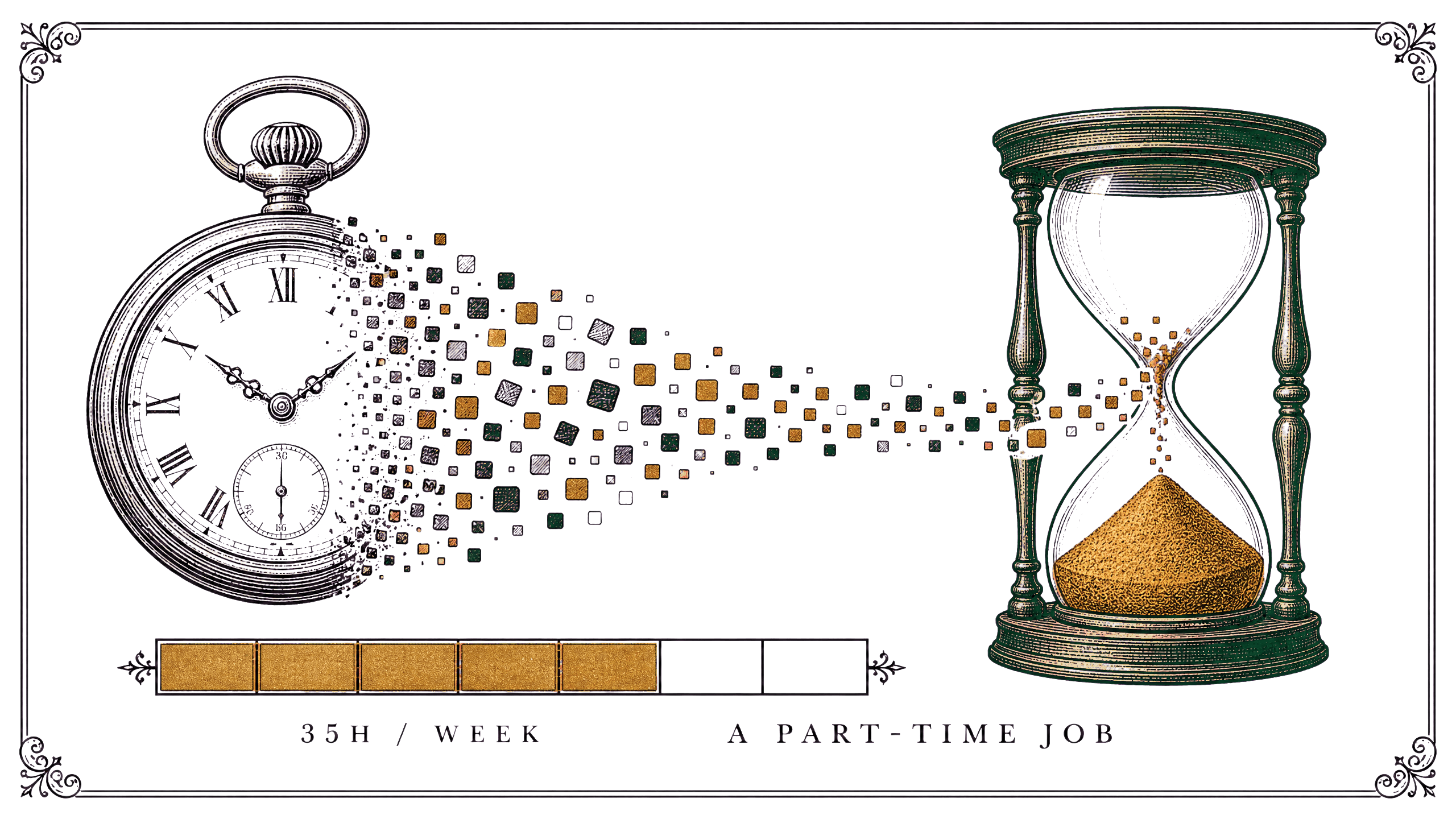
At 5 hours a day, your phone takes years, one evening at a time. Years where the business never starts, the skill never gets built, the Qur’an stays closed, and the person you could become keeps getting postponed.
Your phone didn’t just steal your time. It trained your brain to reject everything that takes patience: salah, Qur’an, deep work, the life you actually want.
Reclaim Your Focus is a 10-minute-a-day reset for ambitious Muslims ready to quiet the noise, rebuild attention, and follow through on what matters.
Less fog. More control. A phone that serves your purpose instead of quietly shaping your day.
I’d sit down to study Arabic, open the book, feel that heaviness you get at the start of anything hard… and within thirty seconds I was on X, “just to warm up.” An hour later I still hadn’t started. (I’m Guled, by the way. I made this.)
If any of these sound like you, you’re in the right place:
It’s a reward problem, and the phone is just the easiest dealer.
Every scroll trains your brain to want faster, easier, louder stimulation. Over time your capacity drops. Your attention shortens. Your motivation gets weaker. Your ability to sit with difficulty disappears. That’s why “just be disciplined” never lasts. You can’t out-discipline an environment that keeps training your nafs in the opposite direction.
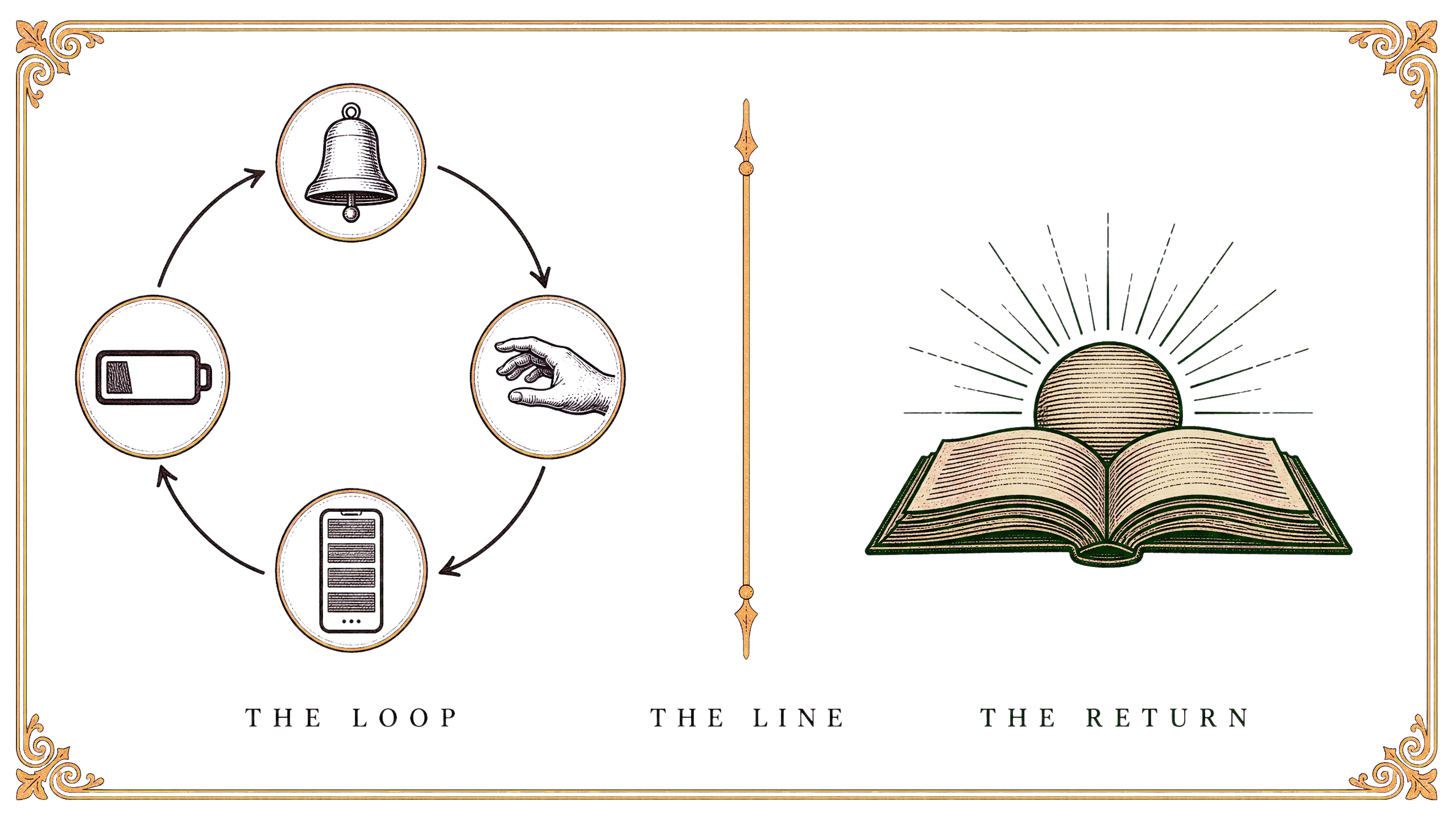
Three losses, running quietly underneath every notification. You already feel the first one. The other two change who you become.
At 5 hours a day, your phone takes years, one evening at a time. Years where the business never starts, the skill never gets built, the Qur’an stays closed, and the person you could become keeps getting postponed.
The bigger loss is who you become after years of avoiding hard things. Your brain starts demanding stimulation before it’ll do any work.
When real life stops feeling rewarding, the craving spreads. More content. More bingeing. More numbing. More late-night doors you wish you never opened. The scroll leaves the door unlocked.
Five hours a day is basically
a part-time job.
On Day 0 the workbook does this math with your own number. Fair warning, it’s not fun.
You know you’re capable. That’s what makes it painful. You can see what you could build, but every day the screen gets chosen over the work.
You say you’ll change at night. By morning, the same loop starts again. Eventually, you stop trusting your own word.
Salah becomes motion without presence. Qur’an feels heavy. Du‘a feels distant. You’re still practicing, but part of you feels offline.
You’re in the room, but not really there. Family, spouse, friends, children, all competing with a screen that keeps pulling you away.
Give yourself a quieter transition into salah: put the phone away, slow down, and turn your attention to Allah.
For years I thought my phone was the problem. So I deleted X… and the next day I was on X in the browser. I deleted YouTube and watched it in Chrome instead. In the end I had to put a screen time limit on Chrome itself.
Meanwhile I’d start things strong and stall by month two. EVERY time.
What finally worked was a handful of small changes. I made the feeds slow enough to reach that I’d stop and ask, “Do I actually want this?” (Most of the time, I didn’t.) I started paying attention to the moment right before I picked up my phone. And I got back into slow things, like reading. I started with huge 1,500-page novels, the kind that pull you along. Now you couldn’t pay me to stop.
Reclaim Your Focus is all of that, turned into a week you can actually finish. And every day has a du‘a, because none of us does this on our own strength.
Guled Abdullah
A 7-day reset to lower stimulation, restore attention, and rebuild your ability to do hard things again.
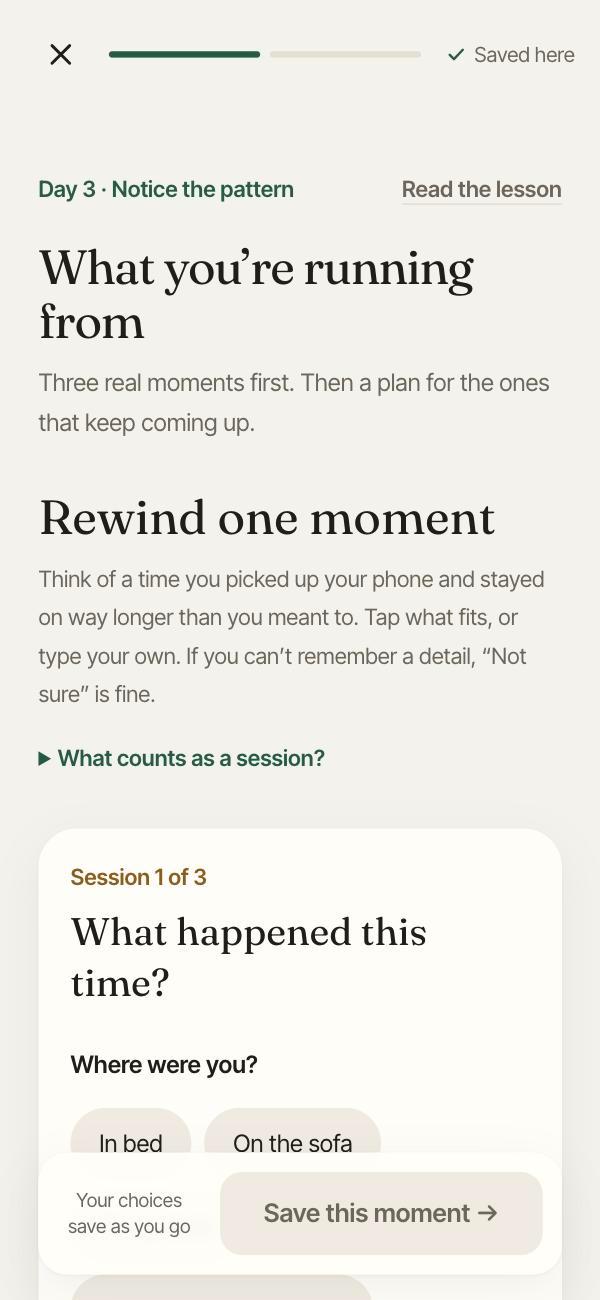
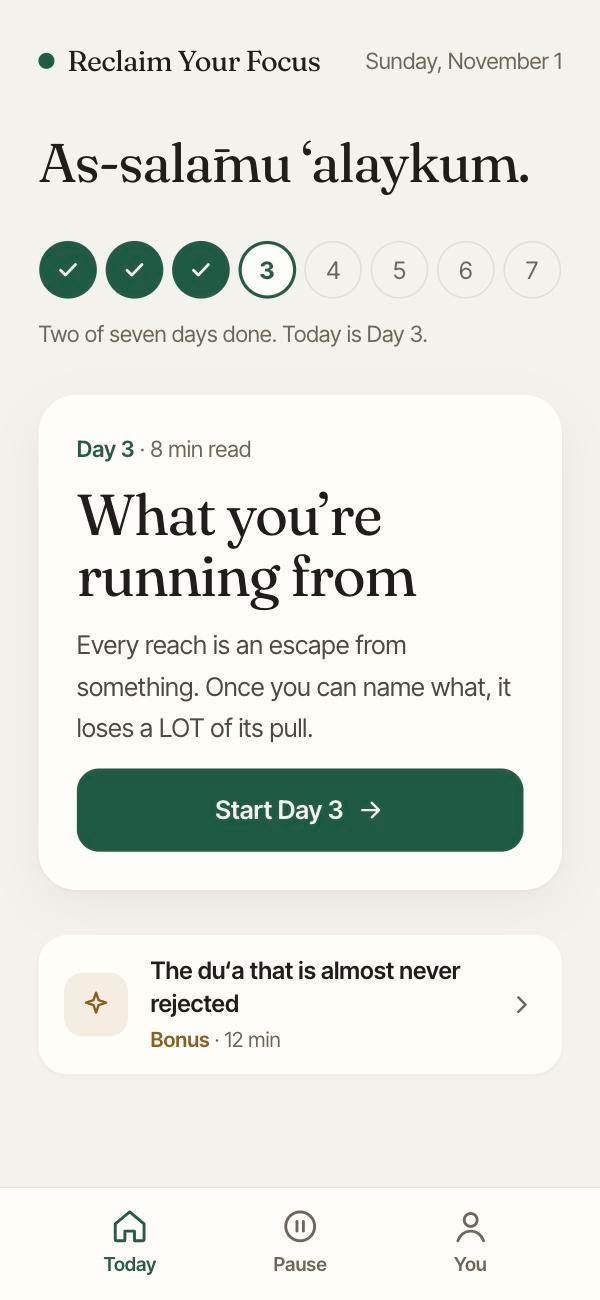
Each day is a short lesson and a few questions, inside a web app that turns what you learn into action. Sign in on your phone or laptop and Today shows you exactly where you are.
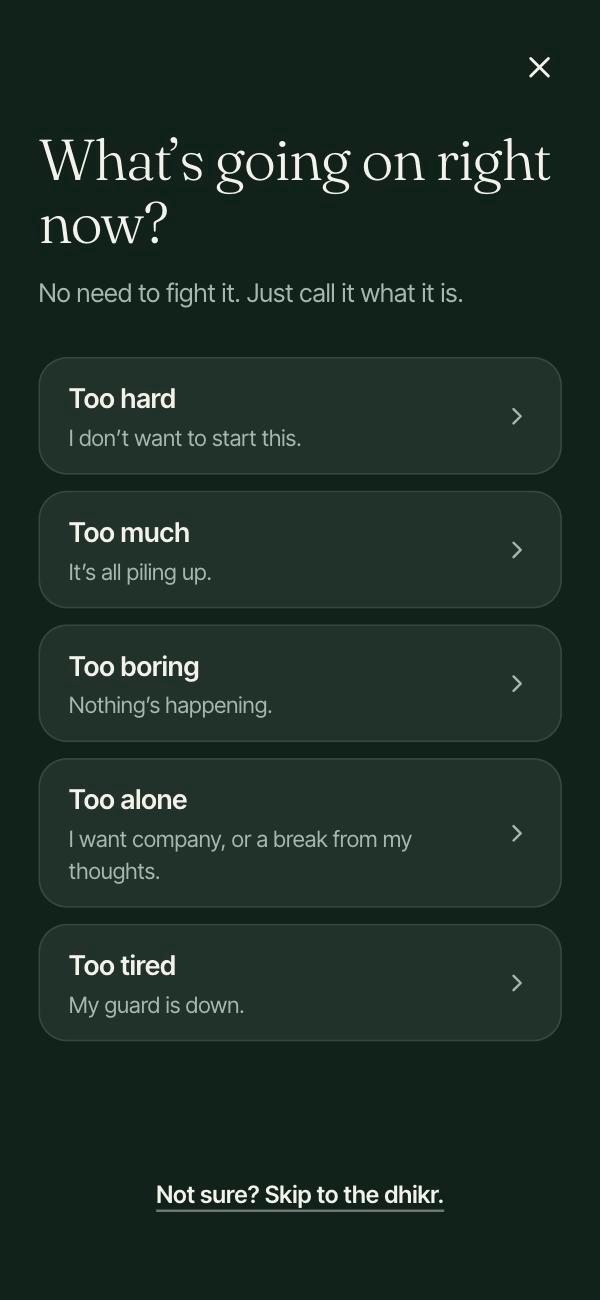
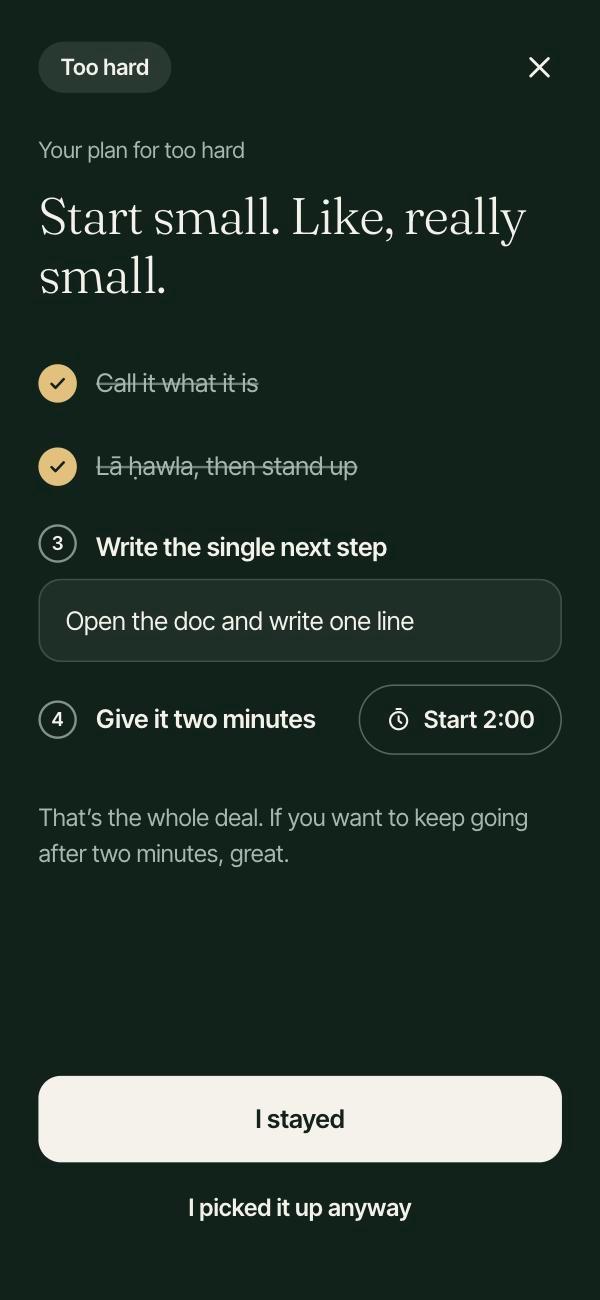
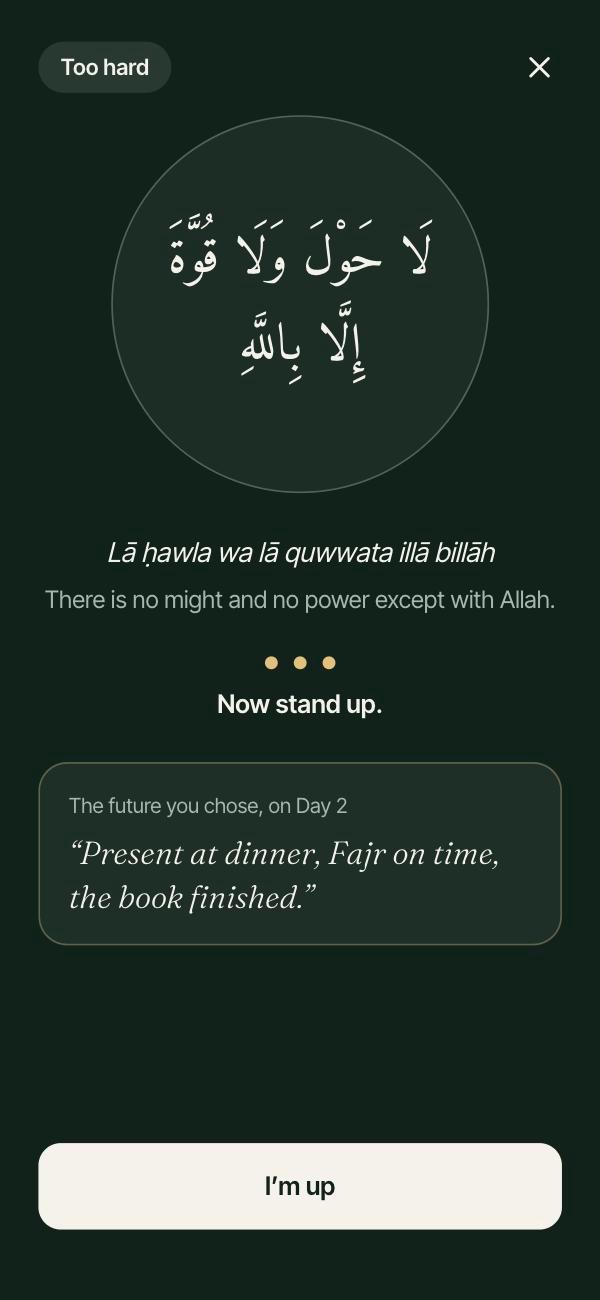
Then there’s Pause, for the moment you feel the pull. It walks you through what to do right then, so you don’t have to remember anything when your guard is down.
The lessons give you the system. The app helps you live it.
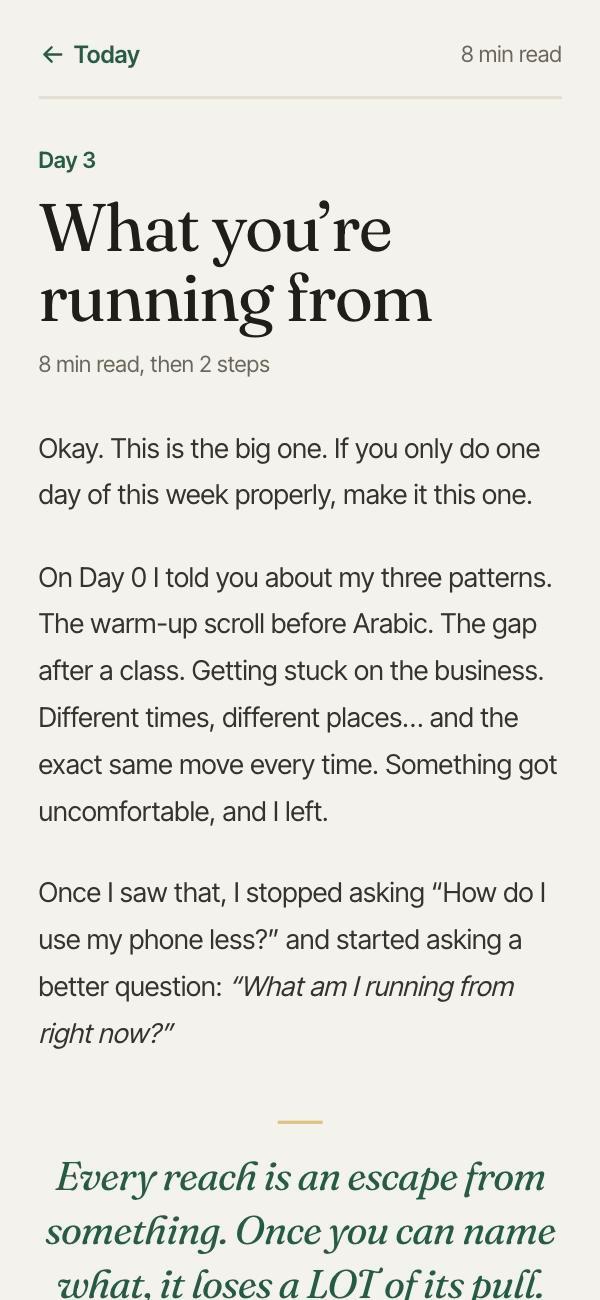
Understand the pattern. Complete the action. Practice your return.
Your answers build up as you go, so by Day 7 you can see the whole week at a glance.
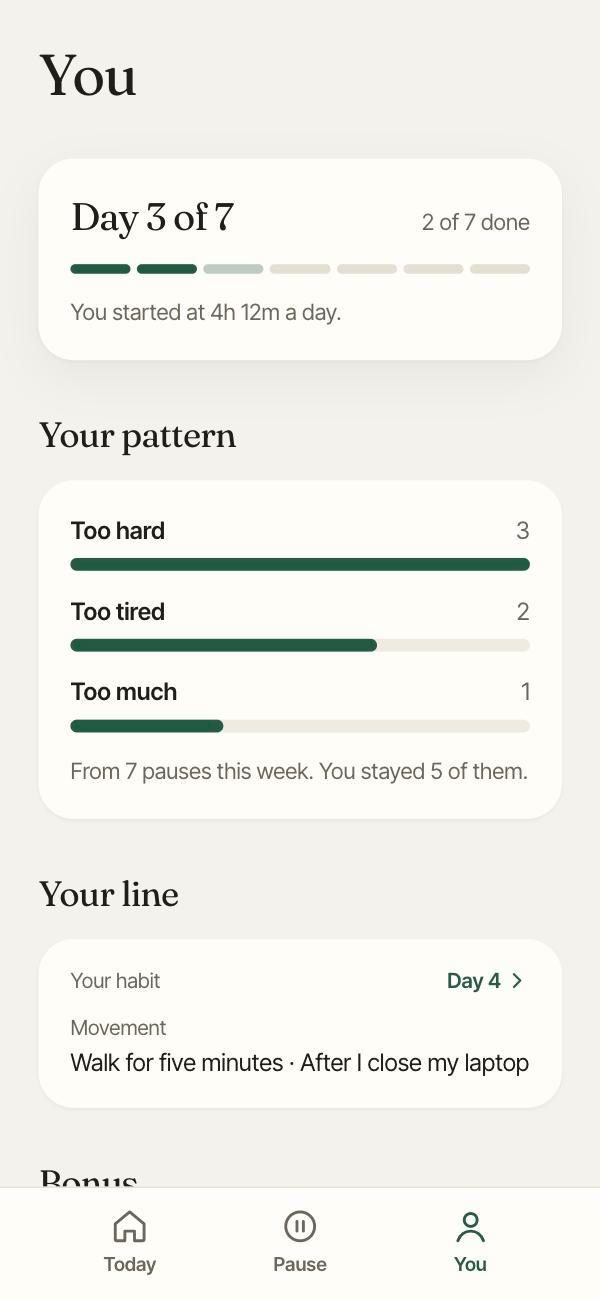
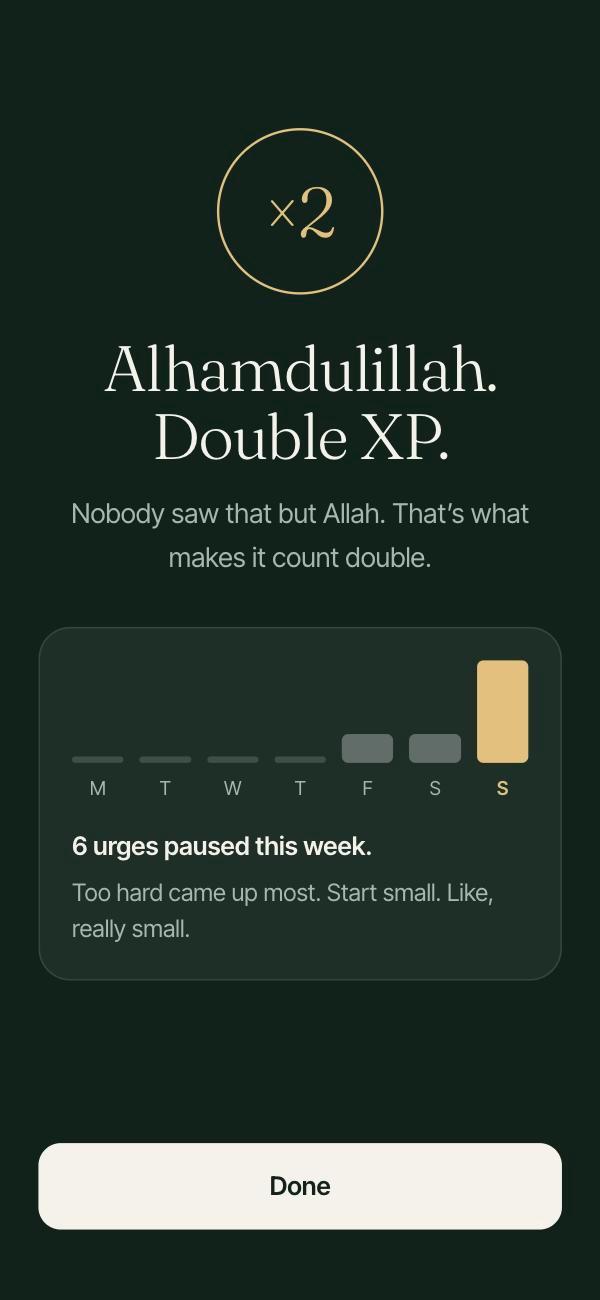
Every pause is saved, so you can see which moments pull you in most and how often you stayed.
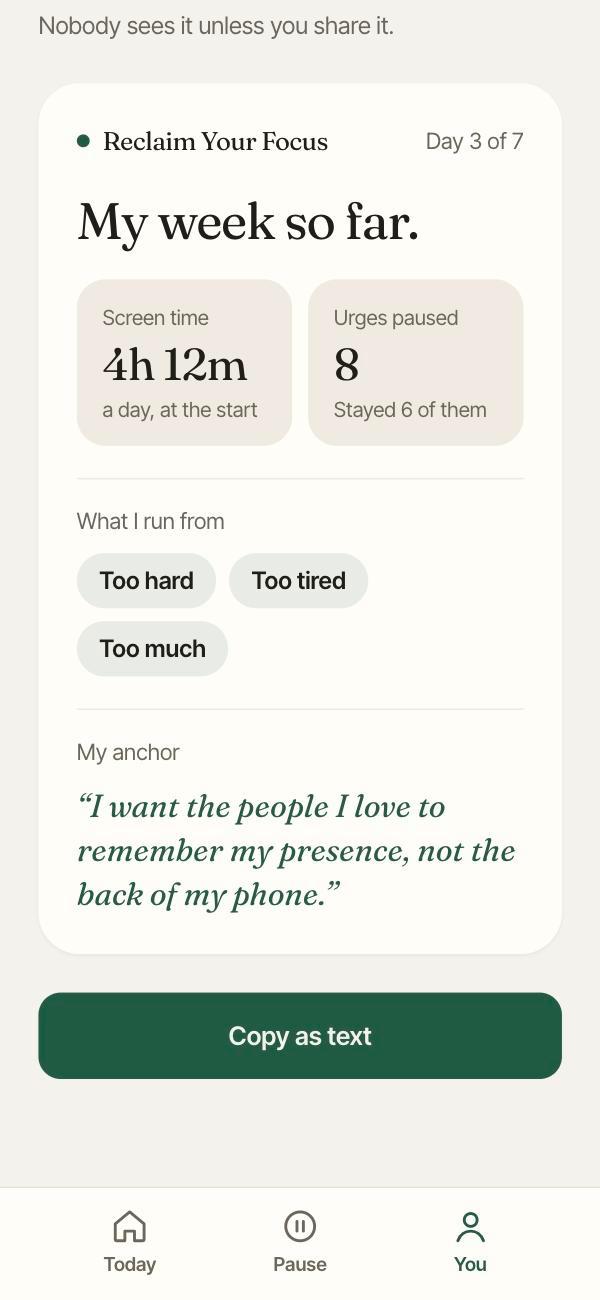
One card with your week on it, ready to send to someone who’ll keep you honest.
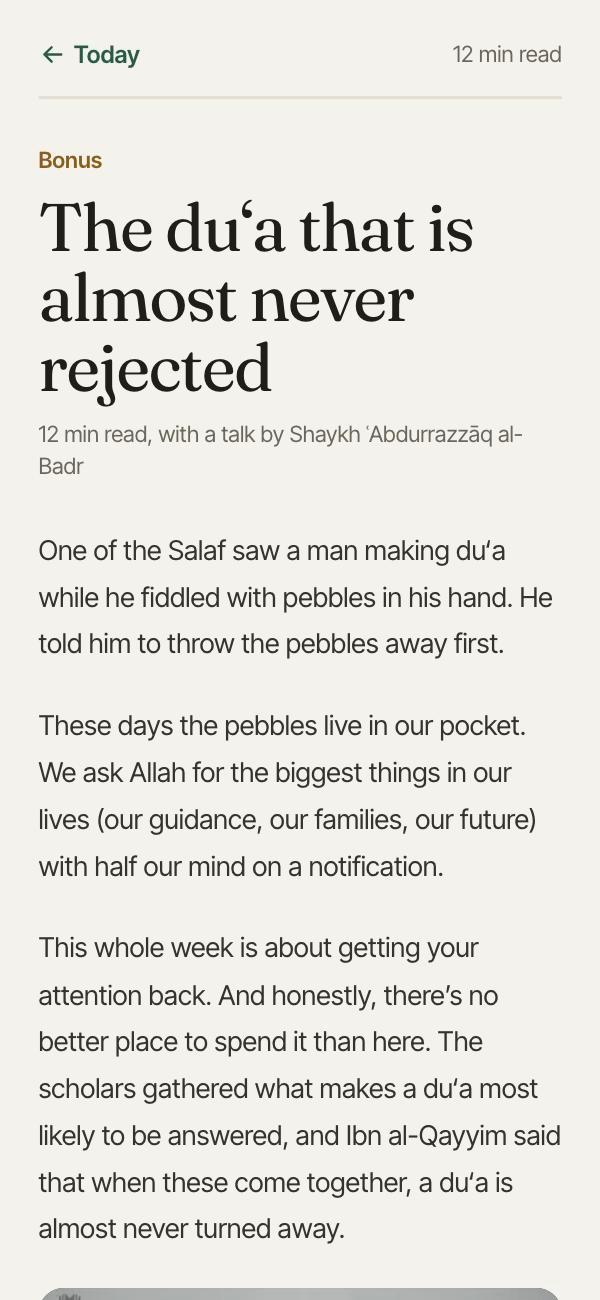
The du‘a that is almost never rejected, with a talk by Shaykh ‘Abdurrazzāq al-Badr.
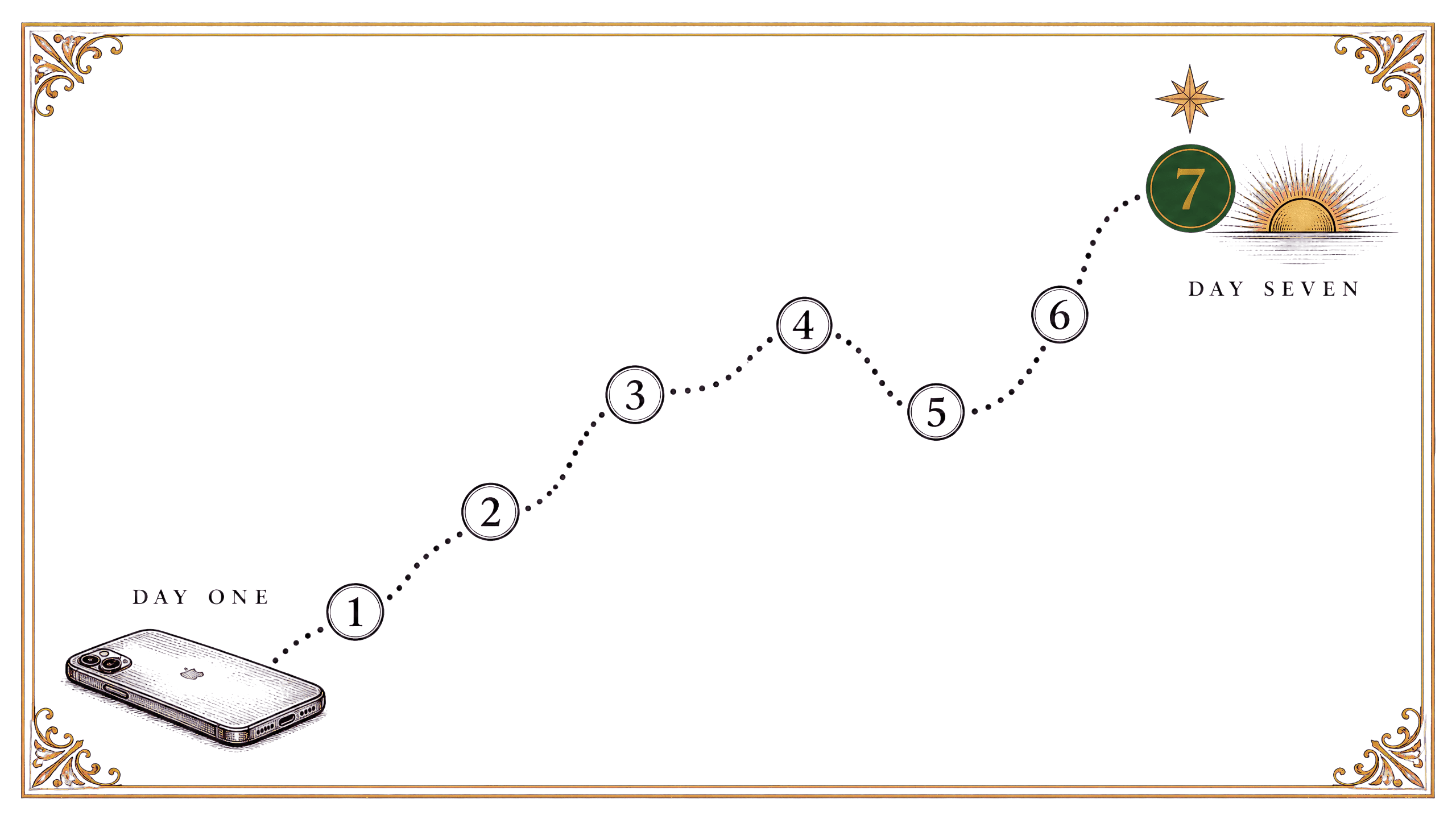
One lesson a day, and each one ends with one thing to do today. Do them back to back or take your time. Your answers save as you go.
Why one scroll never stays at “just five minutes,” and why deleting apps never stuck for me. Today you learn the loop you’re in, and what it’s been costing you.
Stop for one second before you unlock your phone and name what’s going on, in one word.
“When I’m asked about this hour, what do I want to have done with it?”
You compare your phone’s own screen time report with itself, a week apart. The app checks both reports come from the same phone and cover the same number of days, so you’re comparing like with like.
Daily screen time, pickups and your top three apps, straight from the report. Then you decide what happens to each app.
Same report, a week later. If it dropped a lot, alhamdulillah. If it barely moved, look at the other stuff. Did you catch yourself sooner? Did you come back faster after a slip? Those usually change first.
It’s written for Muslims, with the Qur’an and Sunnah behind every day. If that’s not you, there are better fits out there.
One payment and it’s yours. Do the week now, and come back to it whenever you need a reset.
The lessons and the app live together. Sign in once and Today shows you where you are.
Do the week at your own pace. If it doesn’t help, email us within 30 days of buying and you’ll get your money back. No hoops.
No. Screen time is only the surface. This is about reclaiming your attention, energy, self-respect, and ability to do hard things again.
Same here, for years. For me, discipline meant fighting the urge with my jaw clenched, which kept all my attention on the phone. This week you change your phone so the feeds are harder to reach, find the moments that set you off, and practice doing hard things again.
Eight short lessons (Day 0 to Day 7) with a few questions after each one, and the app they live in. The app has Pause for the moment you feel the pull, a You tab that shows your pattern and your standards, a summary card you can share, and a bonus lesson on the du‘a that is almost never rejected.
Most days take about ten minutes: a lesson of 4 to 8 minutes, then the questions. Day 2 asks you to set a timer and write for fifteen minutes. Day 3 is the longest lesson, and the most important one.
No download. It runs in your browser on your phone or laptop. After you buy, create a password with the email you used at checkout, verify it, and you’ll land on Day 0.
That’s fine. Your answers save as you go, so you pick up exactly where you left off. The days work best one after another, but you set the pace.
That’s the point. Your phone has been training your brain to avoid the very things that require patience, depth, and presence. This reset helps you quiet the noise so salah, Qur’an, Arabic, deep work, and business-building become easier to actually show up for.
If it doesn’t help, email us within 30 days of buying and you’ll get your money back. No hoops.
On Day 7 you pick one thing to put it into for the next 90 days. A surah to memorize, a skill, the business, your health. Something you’ll be glad you built, in this life and the next.